By Ashwini Shankar, Chennai
The topics touched in this article will be:
Padma Subrahmanyam's elucidation of Natya Shastra's Recakas
* Role of Recakas in producing Rasas
* What makes the dance attractive, beautiful and interesting
* Kaisiki vs. robotic movements in terms of mechanical engineering
* Why classical Indian dance proper is a solo dance
* Laya and 22 Sruthis
* Why Bharata Muni didn't allow men to sing (and the proof that most dancers and rasikas are actually deaf)
* Why Anita Ratnam is fond of her Tai Chi classes
* Anga Suddham, modes of movements and calligraphy
* The Tantric explanations of everything in terms of 3 gunas, 5 elements, the vrittis and more
* Difference between true art, factory-produced merchandise, and garbage
In her book on the Karanas, Padma Subrahmanyam boldly attempted to pinpoint what is dance and what is not. She builds much of her explanation around the term Recaka. To give you an idea of what the mind-boggling variety of, for example, the Pada (feet) Recakas alone include, these "may utilize the space on the sides, move forward, slip or glide, waver, quiver, shake, proceed, turn away, swerve, sway, get pushed, jerk, slide, raise, lower, draw, release or whirl." Padma Subrahmanyam says, though, that Recakas "cannot be enlisted or enumerated." She also uses the terms Prthagbhava (clearly / sharply outlined) and Valana (smooth / blurred) components of movement saying that a performance that makes use of both masterfully "can never be boring even for the uninitiated." All this makes sense, while I am yet to understand her identification of Anga Suddham with Prthagbhava alone.
Alathur Vijayakumar, the founder of Kalavardhanis, thought he discovered America when he said that he arrived at a formula that detects the "presence of grace" (or rather, the presence of life) in a particular dance sequence. Any robotic movement (which the break dance or army soldiers marching seeks to emulate) can very accurately be described in terms of velocity (V) and acceleration (V²) and jerk (V³). Padma Subrahmanyam says, "...if the intensity (of movement) is constant, the actions suffer a lack of variety. The lines may be defined, lucid and distinct in every action with clarity even in the divergence of the movements. In such a convoy of actions, every movement follows disconnectedly, without getting dissolved into one another. Hence there is a danger of killing grace." She says that the word Valana signifies that "each movement glides into another in a graceful manner."
Any psychiatrist or graphologist will tell you that if the letters in your handwriting are not connected, it means you think incoherently, and you have a good chance of becoming a schizophrenic in the future. Exposure to the schizophrenic dance performances is tantamount to eating food full of chemical pesticides. The organic movements full of life, especially the kaisiki (graceful feminine) type movements, are extremely complex and each is unique (just like every live flower is unique) as the expression of the dancer's manodharma. Their presence in dance can only be approximately described in terms of infinite number of components: V, V², V³,..., V∞ , and the speed graph will be way too complex.
The slight deviations from the impeccably "perfect" computer-generated standard are inherent in classical Indian dance. The deviations that create beauty are predominantly Sattvic, though, depending on the character, they may contain a good dose of Rajas. The ugly deviations are the results of the dancer's laziness or inability to follow the proper trajectory (Anga Suddham). These are the Tamasic deviations (look at the 3 words "Dance" again).
Now, there are some politically incorrect and undemocratic conclusions that the senior dancers who hate Bharata Muni will abhor. Even if you are born with the Sattva as the dominant component of your ("Brahmin") nature, your body, emotions and mind will be more Rajasic in the teenage years, and will be gradually more and more Tamasic as you grow older. (Yoga is the only method of changing this tendency). Our ability to understand, to remember, and to learn something new depends on the amount of Sattva in us.
I find it very amusing when the "senior" dancers dare to say that they somehow "explore the Sringara rasa" even though their recitals are devoid of many of the 10 kinds of grace of the Sahaja type and of most of the 7 of A-yantaja type, all of which are part of the Valana-rich Kaisiki and all of which, according to Bharata Muni, can be found in the movements of young women only. A very interesting element of beauty is among the 10 Sahaja graces: Vicchitti (dishabille) is "the great beauty that results from the slightly careless placing of garlands, clothes, ornaments and unguents."
Why is the classical Indian dance proper a solo dance? Factory-produced latex flowers can be compared with the dance styles that are suitable for group performances where the dancers perform identical movements at the same time. To achieve the perfect "synchronization," the movements have to be as plain ("perfect-shaped") as the latex orchids (or one of the 3 words "Dance" on the right). Live flowers are never perfect-shaped and never have "geometric" appearance. If you are half-blind, the easiest method of detecting latex flowers is to smell them. No fragrance, no rasa. (Make sure the smell is not coming from your own hair where you had poured half a bottle of expensive perfume). "Recakas impearl the Nritta, make it shine and cause complete aesthetic satisfaction," says Padma Subrahmanyam. Recakas are like spices in food. Well, the food has to be bland enough to please the western palate.
In Tantra, the square represents the angular, robust and firm element of earth and Muladhara chakra. The rounded silver Moon crescent represents the element of water: cohesion, smoothness and life and... sexual energies of the Swadhisthana chakra. Swadhisthana is associated with emotion, which means that the dance without Valana is devoid of emotion. And because one of the 6 vritti petals of Swadhisthana represents affection, it means that the dancer who does not develop the Swadhisthana will have a big problem attracting the rasikas, especially the young rasikas of the opposite sex. As Swadhisthana is positioned higher than Muladhara, it means that the movements, before being expressed in the physical body, have to follow the movements of the subtle body (this is why Anita Ratnam is fond of her Tai Chi classes and will explain to us how body movements are supposed to spring from Tan Tien). The western (earthly) materialistic culture considers only the physical (sharply defined) body (sthula sharira), so their reliance on the muladhara techniques is obvious.
Padma Subrahmanyam compares the Recakas with Gamakas of Carnatic music, and says that the "Gamakas are the very life of the Raga." Referring to Bharata Muni's 22 Sruthi (microtone) system, she says that the "Gamakas are caused through a webbed state of the microtones, built on the semi-tones and tones of the musical notes." Have you seen many dancers whose laya is so good that their Recakas follow the microtones too?
If body movement can be described by a speed graph, the music is represented by its sound wave graph. Before you read on, you should define the distinction between music and noise, and between singing and shouting. (hint: analyse the sound wave graph). The graph for the violin will be much more plain than the graph for veena, the instrument essential for learning gamakas in vocal music. If Saraswathi holds a veena (not a violin, electric guitar or sax) in her hands, it's because it is the veena that is most suitable for accompanying the Recakas. The arrival of the budget electric amplification greatly reduced the popularity of the veena, as the sound coming from even the best loudspeakers in the Chennai sabhas blurred the music beyond recognition. After the age of 40, normal people become so Tamasic that they can't hear anything above 14 kHz. The ageing rasikas (except the ones who daily try to exercise their ears!) grew hard of hearing and came to prefer the Italian violin.
While there is software that can impeccably mimic any male voice, there is no software that can analyze and generate a female voice. If the male voices relate to the consonants, and the drums, the women's relate to the vowels, are far more complex, loaded with far more subtle nuances and shades of feelings. After all, isn't the world of emotion the woman's world? Bharata Muni explains that "Though men know the rules of singing in their traditional characteristics, their songs being devoid of sweetness, do not create beauty." (XXXV, 35-36). "Generally, songs are suited to women, and recitatives are suited for men... The good quality in women's recitation and sweetness in men's songs should be considered as an acquired skill, and not part of their nature. If men lead (in songs) and the songs possess good characteristics, but have no sweetness, then these impart no beauty... There may be (allowed) a loss of proper note in women's songs and playing of musical instruments. But this will not be sweet to the ear in case of men" (XXXII, 503-511). Sounds quite discriminatory, doesn't it? Note, Bharata Muni keeps saying that "The singer should be of a young age."
Ashwini (a pen name) is a young dance critic in Chennai who embarked on a long journey of recovering the celestial dance of the devas and apsaras from its pale and distorted reflections occasionally seen in the best Bharatanatyam and other classical Indian dance recitals.
Showing posts with label Bharatanatyam dance dress. Show all posts
Showing posts with label Bharatanatyam dance dress. Show all posts
Tuesday, February 8, 2011


Sunday, January 30, 2011
Bharatanatyam dance dress color selections
At http://www.dancecostumesandjewelry.com/ you can submit the measurements accurately online and select the color of dance costumes as you wish. There is no limitation. In fact you can even upload a photo of the sample dance dress you have in mind too. We have tailors in different states in India. Most of our Bharatantyam dresses are stitched in Chennai and the Kuchipudi dresses are stitched in Hyderabad. Here are some samples of fast moving dress colors we do. This is to just give you an idea. We do not limit the color combination or style of the dance dress as we mentioned earlier. We have skirt style and pant style Bharatanatyam dress. Also we have 2 fan and 3 fan Bharatanatyam costumes. In our online store, you decide the color, style and the material.
Below we have shown some art silk material Bharatanatyam costumes.


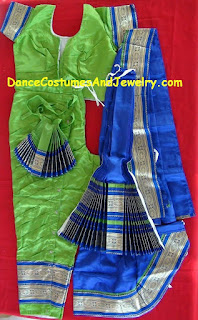


 Many thanks for looking at our sample pictures. Now please visit http://www.dancecostumesandjewelry.com/ and place your order. Please remember, all our costumes are stitched in India and so you have to wait at least 4 weeks to get them delivered to you if your are in US. Outside US delivery dates may vary depending upon the shipping method you have selected.
Below we have shown some art silk material Bharatanatyam costumes.


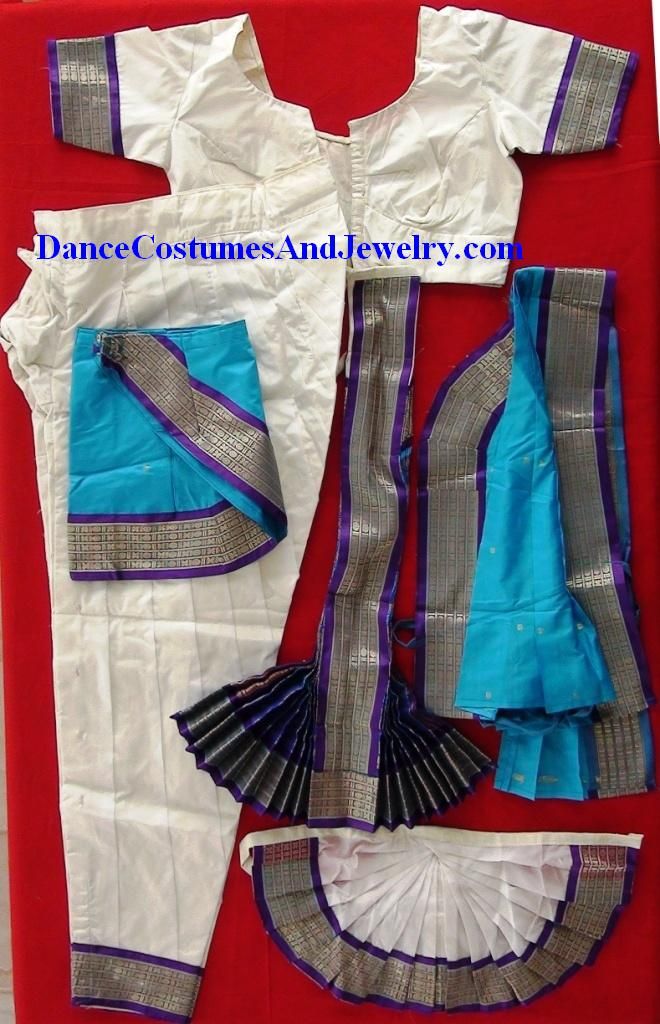

 Many thanks for looking at our sample pictures. Now please visit http://www.dancecostumesandjewelry.com/ and place your order. Please remember, all our costumes are stitched in India and so you have to wait at least 4 weeks to get them delivered to you if your are in US. Outside US delivery dates may vary depending upon the shipping method you have selected.
We will post more pictures soon.
Till then - have fun dancing ....
Monday, October 11, 2010
Kuchipudi and Bharatanatyam dance dress
Both Kuchipudi and Bharatanatyam are originated from southern states of India. Kuchipudi is the traditional Indian classical dance of Andhra Pradesh whereas the classical dance Bharatnatyam is originated from Tamilnadu. Bharatanatyam was formed from the ancient art of Cathir which were revived in the 19th century. Cathir was the traditional performing art of the temple dancers (Devadasi) portraying ancient dance forms. Kuchipudi as a classical dance form achieved excellence during the rule of Abul Hasan Qutb Shah of the Golconda Dynasty. The King was very much impressed with this dance form and he gave 600 acres of land to the Kuchipudi Brahmins for the grand presenting of this art form.
Cathir and Bharatnatyam are dance forms primarily inspired by the sculptures of Chidambaram Temple. The name Bharatnatyam denotes BHAvam, RAgam and TAlam. BHAvam means expression, RAgam means Music, TAlam means Rhythm and Natyam meaning dance.
Bharatnatyam is known for its elegance, grace, softness, clarity and sculptured poses. On the other hand, most of the poses in Kuchipudi are brisk, flat-footed, dazzling and overall curved having more rounded poses.
Bharatanatyam Dance dress
The commonly used styles in Bharatanatyam Costumes are the the Skirt (Saree) Style or the Pyjama Style with two or three fans. Dancers wear costumes made of silk sarees with gold kasavu (zari) designs. The pleats in these costumes, which are known as fans, opens beautifully when the dancer forms a particular posture ara-mandi (half sitting) and muzhu-mandi (full sitting). Since the real Silk saree costumes are very expensive, art silk material is also used for making the dress. Art Silk material looks like real silk but is not as delicate as the real silk fabrick. The artificial Silk is a mix of synthetic silk and real silk.
Kuchipudi Dance Costumes
There is not much of a difference between Bharatanatyam and Kuchipudi costumes. The cross pleats and the Katcham that comes at the back are the main differences in the Kuchipudi costume.
In short:
1)Bharatnatyam - Classical dance from Tamil Nadu and Kuchipudi - classical dance from Andhra Pradesh.
2)Bharatnatyam represents and brings out inner fire within the human body wheras Kuchipudi expresses mankinds desire to unite with God.
3)The Bharatnatyam costumes have two/three fans of different lengths, the Kuchipudi dresses have a single fan.
Cathir and Bharatnatyam are dance forms primarily inspired by the sculptures of Chidambaram Temple. The name Bharatnatyam denotes BHAvam, RAgam and TAlam. BHAvam means expression, RAgam means Music, TAlam means Rhythm and Natyam meaning dance.
Bharatnatyam is known for its elegance, grace, softness, clarity and sculptured poses. On the other hand, most of the poses in Kuchipudi are brisk, flat-footed, dazzling and overall curved having more rounded poses.
Bharatanatyam Dance dress
The commonly used styles in Bharatanatyam Costumes are the the Skirt (Saree) Style or the Pyjama Style with two or three fans. Dancers wear costumes made of silk sarees with gold kasavu (zari) designs. The pleats in these costumes, which are known as fans, opens beautifully when the dancer forms a particular posture ara-mandi (half sitting) and muzhu-mandi (full sitting). Since the real Silk saree costumes are very expensive, art silk material is also used for making the dress. Art Silk material looks like real silk but is not as delicate as the real silk fabrick. The artificial Silk is a mix of synthetic silk and real silk.
Kuchipudi Dance Costumes
There is not much of a difference between Bharatanatyam and Kuchipudi costumes. The cross pleats and the Katcham that comes at the back are the main differences in the Kuchipudi costume.
In short:
1)Bharatnatyam - Classical dance from Tamil Nadu and Kuchipudi - classical dance from Andhra Pradesh.
2)Bharatnatyam represents and brings out inner fire within the human body wheras Kuchipudi expresses mankinds desire to unite with God.
3)The Bharatnatyam costumes have two/three fans of different lengths, the Kuchipudi dresses have a single fan.
Thursday, February 4, 2010
Bharatanatyam dance dress rental

 Dear reader, We have discontinued the costume rental business. You can order your custom made costume from http://www.dancecostumesandjewelry.com/
 Sorry for the inconvenience!!!!
There are two different types available for rent - the four piece art silk bharatanatyam costume and the six piece art silk bharatanatyam costume. The six piece set is only available for Indian sizes 32 and below. There is a deposit you need to pay after you place the order. This deposit will be returned after we receive the costumes from you after your use. We collect this deposit to make sure the costumes are received back in a good, clean condition. It is your responsibility to return the costumes clean. You may only hand wash the dress if there is some kind of stain got on the costume while its in your custody. Please DO NOT put the dress in a washer or dryer as this may damage the silk material. We don't expect you to iron the costume before you return it, but please make sure to return it clean.
There is a price difference between the two types of dance costumes we rent. The six piece set is expensive because it is the traditional Bharatanatyam dress and you can even use it for your child's arangettram. This is the two fan pattern. Please see the pictures below. This has a pyjama style pant, blouse, two fans, arapatta and dhavani.
Also have a look at our temple jewelry sets. Our dance jewelry sets have all the necessary ornaments for the complete make-up. We have complete imitation dance jewelry sets with belt, long chain, necklace, bangles, jimiki, nath, head-set, mattil and Rakodi for price ranging from $49.00 to $89.00

Subscribe to:
Posts (Atom)